This post may contain affiliate links. As an Amazon Associate, We earn from qualifying purchases if you buy through our links at no extra cost to you. Please read our full disclosure here.
I hung my first set of island pendants way too high. Like, “why do these look like they’re floating near the ceiling” high. I didn’t measure anything. I just stood on a chair, eyeballed it, and figured close enough would work.
It did not work. And patching drill holes in a ceiling you just painted is not how you want to spend a Saturday.
So if you’re standing in your kitchen right now holding a tape measure and absolutely no confidence, I’ve got you.
Below is exactly how high to hang pendant lights over a kitchen island, how your ceiling height shifts that number, how many pendants you actually need for your specific island, and the mistakes that trip up nearly everyone the first time.
No guessing games. No chair-standing required.
Before You Start: The Quick Answer
If you only remember one thing from this whole post, remember this: hang your pendant lights 30 to 36 inches above your countertop.
That’s the sweet spot for most kitchens with standard 8 to 9 foot ceilings. It’s low enough to actually light your workspace and high enough that nobody’s ducking under it to reach the fruit bowl.
But that number isn’t one-size-fits-all, and the rest of this guide walks through exactly when and why it changes.
The Standard Pendant Lighting Height Over Kitchen Island
This 30 to 36 inch rule isn’t just a random design tip someone made up. It comes from how people actually stand and move around an island, not how the lights happen to photograph.
Here’s the logic. Countertops sit around 36 inches off the floor, and most adults fall somewhere between 5’4″ and 6′ tall.
Hang a pendant 30 to 36 inches above that counter, and the bottom of the fixture lands around 60 to 66 inches off the ground, which is right around eye level (or just above it) for most people standing there. That’s what gives you solid task lighting without anyone smacking their head reaching across for a mixing bowl.
Go any lower than 30 inches, and you’ll start blocking sightlines across the island. This matters more than people think, especially if the island doubles as a spot for conversation, homework, or keeping an eye on kids while dinner’s happening.
Go higher than 36 inches, though, and the light spreads out too much before it even reaches the counter. You end up with a dimmer workspace than you probably wanted.
Think of this range as your starting point. Ceiling height is really what pushes the final number up or down from here.
How Ceiling Height Changes the Formula
An 8 foot ceiling and a 10 foot ceiling shouldn’t have pendants hanging at the exact same height, even though the “distance above the counter” idea stays roughly the same. Here’s how the adjustment actually plays out.
If you’ve got a standard 8 foot ceiling, stay closer to the lower end, somewhere around 28 to 30 inches above the counter.
There’s just not a lot of vertical room to work with, so you want enough headroom that the fixture doesn’t feel like it’s swallowing the whole kitchen.
9 foot ceilings are honestly where most kitchens land, and it’s the one situation where the standard 30 to 36 inch rule works pretty much as-is. Not much adjusting needed.
Once you’re at 10 feet or higher, add around 3 inches of height for every foot of ceiling above 8 feet. So a 10 foot ceiling might mean pendants hanging 36 to 40 inches above the counter instead of the standard range. The idea is keeping the fixture visually tied to the island, rather than letting it float awkwardly in a big, empty space above.
If you want a quick formula instead of memorizing ranges: take your ceiling height, subtract 8, multiply by 3, then add that to the low end of the standard range. It’s not perfect science, but it gets you close enough that you won’t need a redo.
How Many Pendant Lights Do You Need
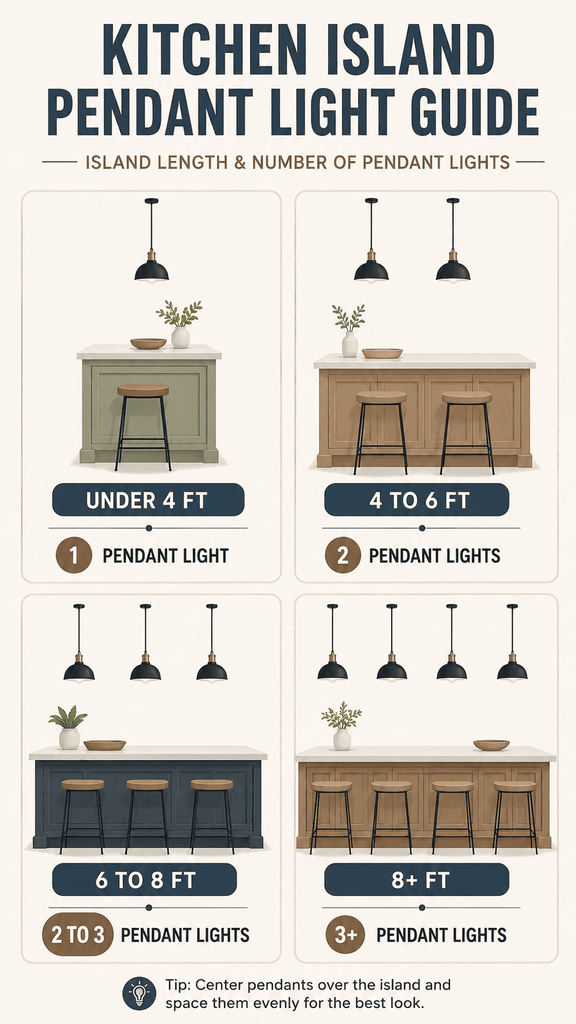
This one comes down almost entirely to island length. Not personal taste, not what’s trending on Pinterest, just how much counter space you’re actually lighting.
- Under 4 feet: one pendant is plenty, or one larger statement fixture on its own
- 4 to 6 feet: two pendants
- 6 to 8 feet: two to three, depending on how big the fixtures are
- 8 feet and up: three or more, or consider a linear fixture instead of separate pendants
A quick note on odd versus even numbers: three pendants tend to look a little more intentional than two, mostly because it avoids that “matching pair” symmetry that can read as slightly generic. That said, two well-chosen fixtures on a smaller island look perfectly fine too.
There’s no wrong answer here as long as the spacing feels even and nothing looks crammed together or lost in empty space.
Pendant Light Spacing Guide
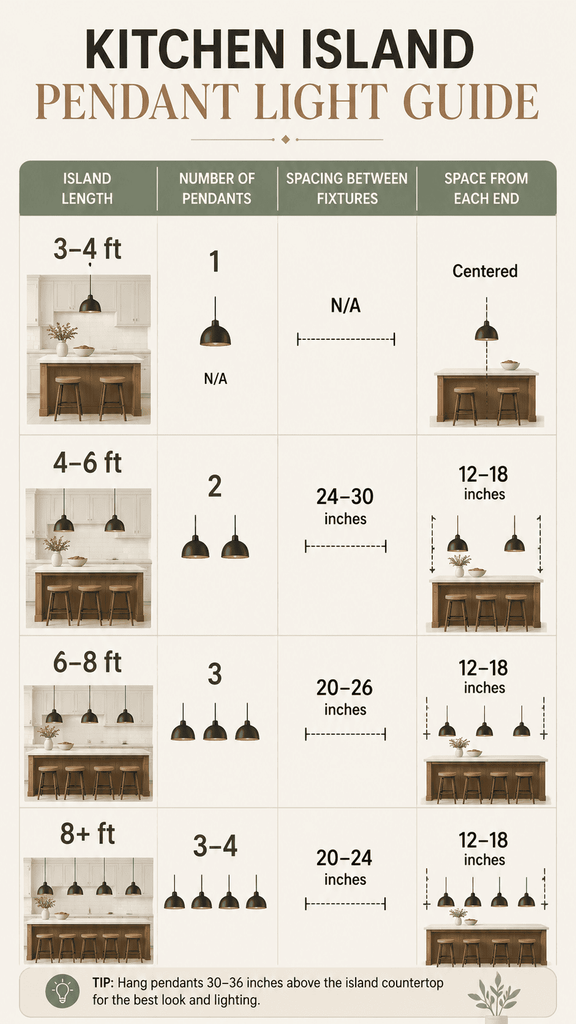
Once you know how many pendants you’re working with, spacing is what makes them look cohesive instead of randomly placed.
A good rule of thumb: leave roughly 12 to 18 inches of clearance between the end of the island and the nearest pendant on each side. This keeps the lighting centered over the workspace instead of crowding one end (ask me how I know what a lopsided pendant layout looks like).
RELATED: Small Kitchen Ideas That Seriously Make Tiny Spaces Look Bigger
Choosing the Right Pendant Size for Your Island
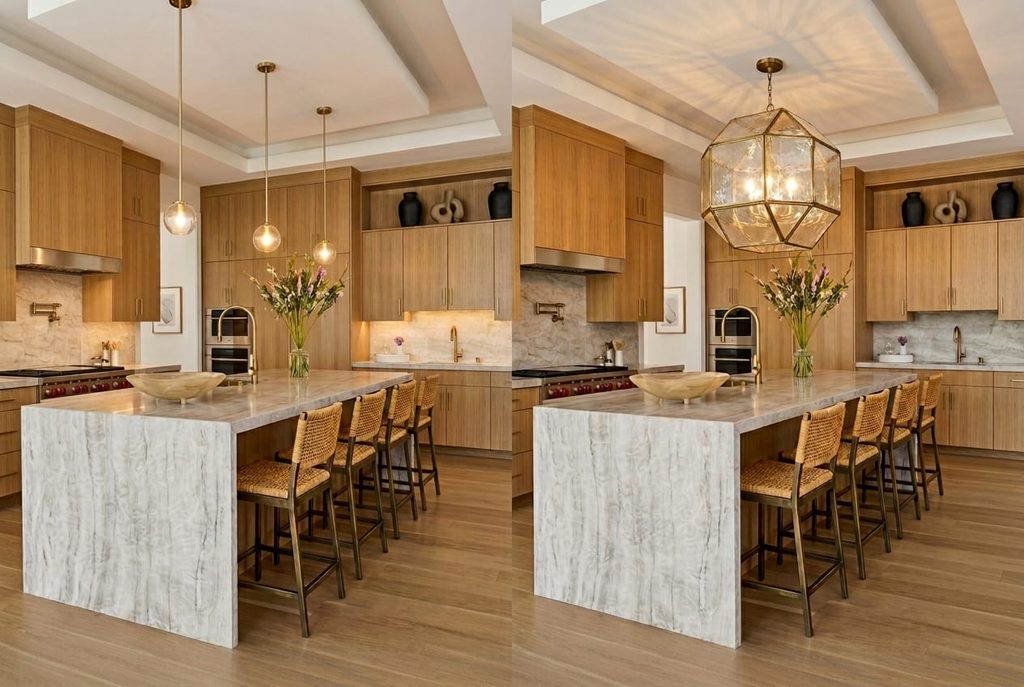
Height and spacing get most of the attention, but size is where a lot of otherwise well-measured kitchens still end up looking a little off.
Mini pendants work best on smaller islands, or when you’re lining up three or more fixtures in a row. They keep things feeling light instead of heavy overhead.
If you’re not sure where to start, standard-size pendants are the safe bet. They fit most mid-size islands running two to three fixtures and rarely look wrong.
Then there’s statement or oversized pendants, which shine as a single dramatic piece, or as a pair spaced further apart than usual. Longer islands especially benefit from this approach: fewer, bigger visual moments instead of a repetitive row of smaller lights.
For a rough sizing guide, add your kitchen’s length and width in feet, and use that number in inches as roughly the right diameter for a single pendant.
Going with multiple fixtures? Split that number across them so the total visual weight still feels balanced, not like your island is wearing too much jewelry.
Common Pendant Lighting Height Mistakes to Avoid
Nearly every pendant lighting complaint I’ve ever heard (or made myself) traces back to one of these four things.
- Hanging too high. This is the one I’m personally guilty of. It looks totally fine from across the room, and then the moment you’re actually standing at the island trying to see what you’re chopping, something feels off and you can’t quite place why. It’s the height.
- Hanging too low. Just as common, usually with taller pendants that never got measured before install day. If you catch yourself tilting your head to see past them to the other side of the island, that’s your sign.
- Uneven spacing. This sounds minor until the lights are actually on. Shadows have a way of exposing even a two-inch difference between fixtures that looked fine on paper. Measure twice. Actually measure three times if you’re anything like me.
- Ignoring a sloped or vaulted ceiling. All the standard height rules above assume a flat ceiling, so if yours slopes, you’ll need adjustable cords or a sloped-ceiling adapter kit to get the pendants landing at the same final height, even though they’re attaching at different points up top.
Trend Callout: Popular Pendant Styles for Kitchens Right Now
If you’re already in the market for new fixtures, here’s what’s actually showing up in kitchen renovations right now, not just what’s trending for five minutes on social media.


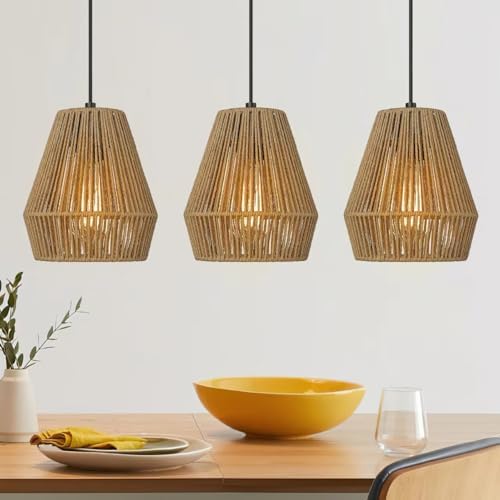

None of this changes the height and spacing math from earlier, by the way. It’s just good to know if you’re already committed to upgrading your fixtures.
RELATED: Kitchen Island Decor Ideas for Style and Function
Adjustable vs Fixed-Height Pendants: Which to Choose
This is really a decision you want to make before buying, not after the fixture is already hanging crooked in a box on your counter.
Adjustable cord or chain pendants let you fine-tune the height after they’re installed, which is genuinely helpful if you’re not 100 percent sure of your measurements or think you might rearrange the island setup someday. They’re also the better pick if you’re dealing with a sloped ceiling.
Fixed-height pendants, on the other hand, come with a set drop length that can’t be changed once installed. They tend to look cleaner and more intentional, but that only holds true if the height was measured correctly beforehand. If you’re confident in your numbers and want that more polished, streamlined look, fixed-height is worth it.
Honestly though, if there’s any doubt in your mind at all, go adjustable. Shortening a cord is a five-minute fix. Returning a fixture because it’s two inches too long is a whole afternoon you didn’t plan for.
FAQ
How high should pendant lights hang over a kitchen island?
Most kitchens look and function best with pendant lights hung 30 to 36 inches above the countertop. This range keeps the fixtures low enough to properly light the workspace while staying high enough that they don’t interfere with sightlines or bump into anyone standing at the island.
Can pendant lights be too low over an island?
Yes, and it’s one of the most common installation mistakes. Pendants hung too low block the view across the island, can interfere with tall appliances or serving dishes, and may even hit taller family members at the wrong angle. If you find yourself tilting your head to see past the fixtures, they need to come up a few inches.
Do all pendant lights need to be the same height?
In most cases, yes. Matching heights across multiple pendants creates a clean, balanced look and is much easier on the eye than uneven fixtures. The one exception is intentional design choices, like a graduated or staggered arrangement, but that should be planned from the start rather than happening by accident.
How do I adjust pendant height for a sloped or vaulted ceiling?
Sloped ceilings need pendants with adjustable cords, chains, or a sloped ceiling adapter kit so each fixture can be set to the same final height even though the ceiling attachment points are uneven. Skipping this step is one of the main reasons pendants end up looking crooked or mismatched on angled ceilings.
What size pendant light do I need for my island?
A simple starting formula is adding the length and width of your kitchen in feet, then using that number in inches as a rough guide for pendant diameter. For multiple pendants, divide that total across your fixtures so the combined visual weight feels balanced rather than overwhelming the space.